
THE DESTINATION REPORT / WORLD WANDER LEDGER
Dishonored 2
An outstanding destination for architectural exploration. Alternate routes and flexible abilities make observation useful, with inventive locations that are more distinctive than the central plot carrying the journey.
Game facts
- Developer
- Arkane Studios
- Publisher
- Bethesda Softworks
- Released
- 11 November 2016
- Platforms
- Windows (Steam edition)
- Model
- Paid game
- PEGI
- 18 · Bad Language, Violence — Steam UK listing
- Players
- Single-player
- Length
- Medium
- Difficulty
- 3 / 5 · Moderate challenge
- Steam Deck
- Playable
PEGI source ↗ · Steam Deck status source ↗
Edition: Base game
The score, explained
The interest and responsiveness of the core decisions and actions.
How progression, exploration and goals fit together.
The coherence of the visual, musical and narrative presentation.
How clearly the game explains its rules and offers useful ways to engage.
The depth of optional goals, alternative approaches and reasons to return.
The core experience
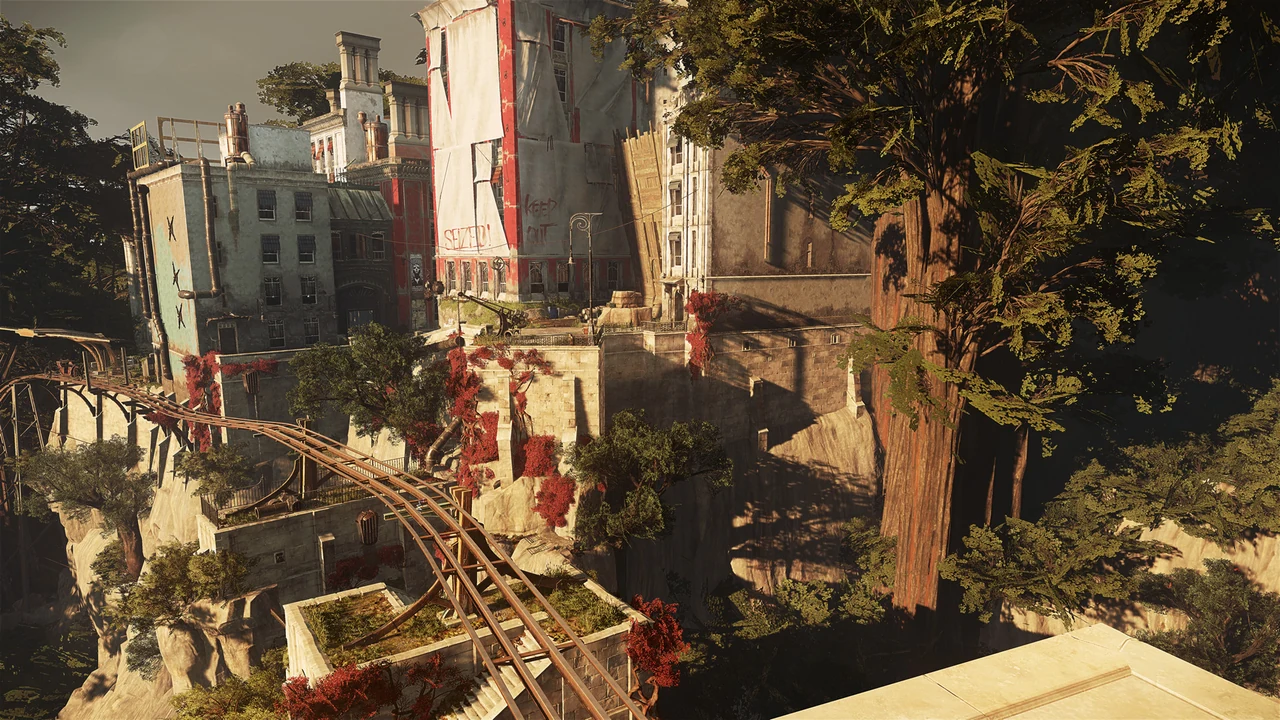
Dishonored 2 introduces exploration through the question of how to enter a guarded place. A street-level doorway is only one possibility in a city full of balconies, windows, service routes and vertical connections. Playing as Emily or Corvo changes the available abilities, which in turn changes how those spaces can be approached. The opening encourages the player to pause before committing to the obvious path. A conversation, a room above the street or a route around a building may reveal useful information and a less direct approach. For an explorer, this makes observation immediately practical. The city is not simply scenery surrounding the objective; its architecture is the main set of tools through which the objective becomes manageable. Progress begins by recognising that the destination matters, but the route chosen to reach it can be equally interesting.
Where it excels
The strongest locations make architecture feel active. The Clockwork Mansion changes its internal arrangement, while the time-shifting investigation at Stilton's manor turns another dimension of the same space into part of the route. More ordinary streets also reward attention through overlooked entrances, small interiors and evidence of the people living there. Abilities expand these opportunities without reducing every solution to the same movement. The result is a particularly rich form of exploration: examining a place can reveal both its history and a practical way through its security. The player is encouraged to interpret the environment, then act on that interpretation. Dishonored 2 is most compelling when the destination becomes less important than the possibilities discovered along the way. Its locations support curiosity with meaningful alternatives rather than offering optional rooms that merely delay arrival at the same single entrance.
The trade-offs
The breadth of possible approaches can be easy to miss. Following a straightforward route remains possible, but doing so may conceal much of the level design that makes the game distinctive. Players need to supply some curiosity themselves, including a willingness to investigate above and around the expected path. The central plot also has less individuality than the strongest locations, so a reader primarily seeking a memorable narrative may judge the journey differently from someone interested in architecture and systems. Stealth and combat impose their own demands on exploration, and an improvised plan can become messy when a guard behaves differently than expected. The game is flexible, but that flexibility does not guarantee an effortless tour. Its recommendation depends on appreciating experimentation, consequences and the possibility of discovering a better route after already attempting a less elegant one.
Who should play it
Choose Dishonored 2 if exploring a place means finding out how it can be used. It suits players who enjoy tracing service routes, studying a room from an unusual angle and combining an ability with an architectural opportunity. The memorable environments reward patience before action, while the choice of protagonist changes the relationship with those spaces. Readers who prefer a direct, heavily signposted journey should recognise that some of the best material emerges through self-directed investigation. This is also a strong recommendation for explorers interested in inhabited places, where security, daily routines and traces of history belong to the same layout. The most useful habit is to look beyond the first workable entrance. A destination may be reached quickly, but understanding its surrounding possibilities is what turns the trip into a distinctive and rewarding expedition.
The verdict
An outstanding destination for architectural exploration. Alternate routes and flexible abilities make observation useful, with inventive locations that are more distinctive than the central plot carrying the journey.
Reasons to play
- Architecture offers meaningful alternatives to the obvious route
- Abilities change how the same spaces can be approached
- The strongest locations make their layout part of the central idea
Reasons to think twice
- Direct play can miss much of the richest environmental design
- The main plot is less distinctive than its best destinations
See the game

Assist & accessibility
Parents’ guide
Players: Single-player. No in-game purchase marker in the checked Steam listing. Separate downloadable content may be sold.
Age classification: 18. Bad Language · Violence Steam UK listing
A useful starting tip
Spend a moment looking above street level before deciding that a guarded entrance is your only practical route.
A different direction
Compare this with TUNIC: A compact island with remarkable depth of discovery. Manual pages and concealed routes repeatedly change the meaning of familiar places, though exploration shares the journey with serious combat and deliberate uncertainty.
Official sources
Reviewed: November 2026
You might also like
 Hollow KnightRead review →
 TUNICRead review →
 ANIMAL WELLRead review →